









|
Fukui Ichiju
福井一壽,
koshirae fittings (dated 1871) In 1855 Fukui Ichiju became a student of Hashimoto Isshi, one of the five most famous students of Goto Ichijo, known as the "Go-Ko Ichijo" (Five tigers of Ichijo). In 1861, Ichiju himself became a student of the very famous Goto Ichijo, at the peak of his career. Fukui Ichiju's style followed closely the teachings of Ichijo. He was very skilled at taka-bori iroe (a raised carved design "painted" using different colored metals). Fukui Ichiju worked in Yamashiro and Musashi provinces into the Meiji period. He was born in 1835 and died in 1903. The inscription on the fuchi states these fittings were made in mid-winter. It is isn't hard to imagine a cold grey day, Ichiju at his work-bench visualizing the simple joys of Spring and Summer, as he carves these fittings. The saya is done in shiny black lacquer with longitudinal gold nashiji streaks, possibly representing a night rain. The design is a Spring and Summer theme with various flowers, grasses, foliage, and butterflies. The silver base metal is decorated using hira-zogan (flush inlay) of various metals, katakiri bori (carving, like the strokes of a painters brush), and raised butterflies in gold, shakudō, and silver, with very fine detail, including multicolored cells in the wings. The fuchi, koiguchi and kojiri are all signed. The fuchi-kashira, kojiri, koiguchi and kurigata are all en-suite, clearly made by the same hand. The backs/insides of the menuki, 'kurigata' and kashira are not accessible to check for signatures. The original tsuba may also have been by Ichiju, but was separated from the koshirae at some point in history. We know the tsuba has been substituted because the original gold foil seppa have cutouts and groves on their backs (visible from the side view in the top right photo below) to accommodate the raised decoration protruding onto the original tsuba's seppa-dai, and are not present on this tsuba. These fittings are part of a toppei style gaiso (complete mounting) for a
suriage katana by the first generation Hizen no Kuni Tadayoshi (肥前図忠吉),
founder of the famous Tadayoshi School (also with NBTHK Tokubetsu Hozon papers).
This toppei type gaiso is Higo in style. A late mounting, very appropriate
for the blade it was made for. |
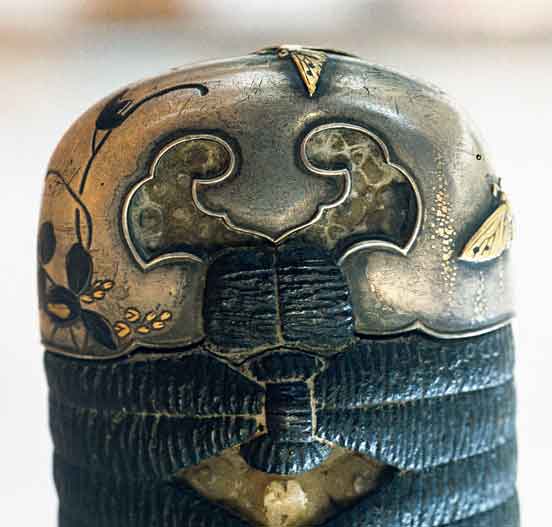
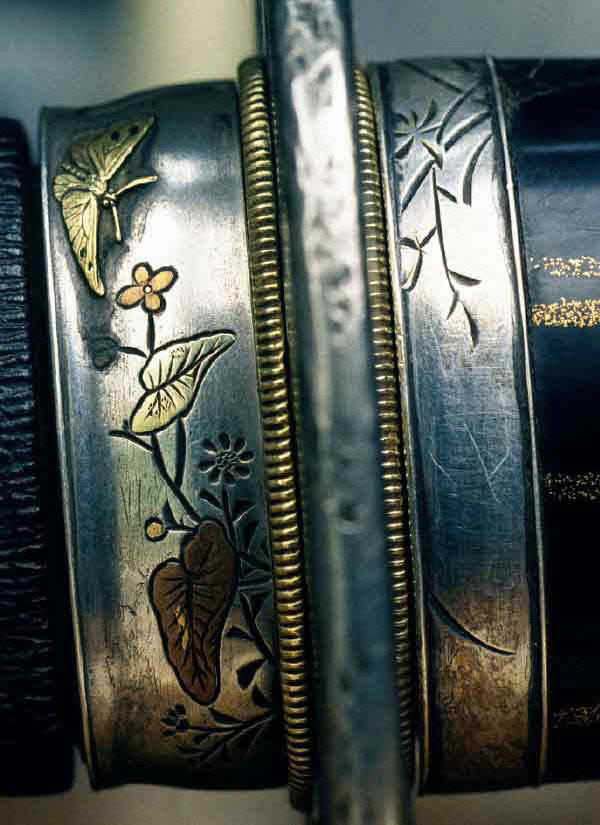
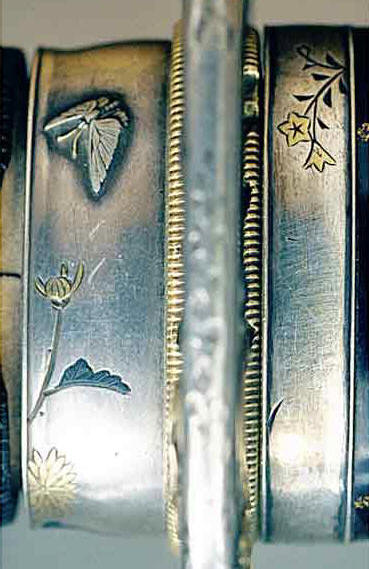
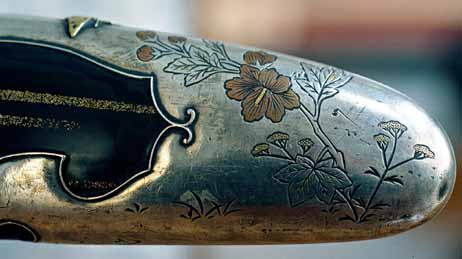
| Part | Signature |
|---|---|
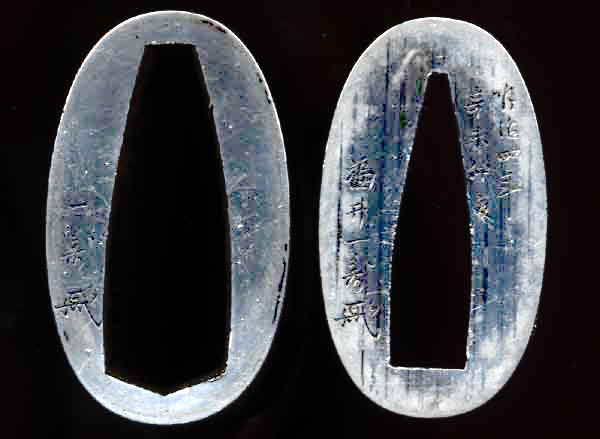
| Fuchi | Meiji Shi Nen / Kanoto-Hitsuji Chuto /
Fukui Ichiju 福井一壽
w/Kao 4th year of Meiji / 8th year of the Zodiac, mid winter (1871) / Fukui Ichiju |
| Kashira | Not signed, or the signature is not visible. |
| Koiguchi | Ichiju w/Kao |
| Kojiri | Ichiju w/Kao |
| Tsuba | Mumei (not signed) |
| Menuki | Not signed, or the signature is not visible. |
| 'Kurigata' | Not signed, or the signature is not visible. |